

Poland expects surge in investment this year, PM says
Investment in Poland is expected to rise nearly 10 percent this year, Prime Minister Donald Tusk said on Wednesday, calling 2026 a period of “turbo acceleration” for the economy despite geopolitical uncertainty and Russia’s ongoing war in Ukraine. It is reported by Upmp.news with reference to “Polskie Radio”.
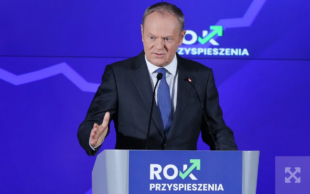
Speaking at a conference at the Warsaw Stock Exchange, Tusk said that while he had previously described 2025 as a “year of investment and breakthrough,” he could now say with greater confidence that 2026 would bring clear economic acceleration.
“I can say with satisfaction that our forecasts—not excessively optimistic—for 2026, the year of this turbo acceleration, point to nearly 10-percent growth in investment,” Tusk said.
‘Oasis of stability and growth’
He described Poland as an “oasis of stability and growth,” arguing that macroeconomic data justify optimism.
Poland’s 3.6 percent economic growth last year placed it among leaders in the European Union, particularly among large and medium-sized economies, he said.
Tusk noted that investment rose 4 percent in 2025, which he said marked a recovery but remained insufficient.
The government plans further stimulus for infrastructure, science, new technologies and startups, he added.
The prime minister said the acceleration should translate not only into stronger macroeconomic indicators but also into improved living standards for Polish families and greater fiscal stability.
Tusk also pointed to the capital market, saying that the Warsaw Stock Exchange rose nearly 50 percent last year, “its strongest performance of the 21st century,” which he said reflected investor confidence at home and abroad.
Finance and Economy Minister Andrzej Domański, who also attended the conference, described 2025 as a genuine “breakthrough year” for the Polish economy.
He cited quarter-by-quarter GDP acceleration, a 7-percent rise in industrial production and nearly 10-percent export growth as evidence of sustained recovery.
Inflation subsided to 2.4 percent, below the target of Poland’s central bank, while “real wages recorded their strongest growth this century,” Domański said.
He added that deregulation, the release of European Union funds—including recovery funds—and increased private and local government investment had supported growth.
He also highlighted Poland’s energy transition, including onshore and offshore wind projects, upgrades to transmission networks and progress on construction of the country’s first nuclear power plant.
Domański set out a medium-term goal of matching Britain in GDP per capita adjusted for price levels within five to six years, driven by sustained investment, improved competitiveness and development of modern sectors such as technology, artificial intelligence and the space industry.
(gs)
Source: TVP Info, IAR, PAP